TL;DR: The Quick Summary for Busy Managers
Multilingual warehouse software is not a nice-to-have for global brands only. In Australia, New Zealand, the UK, and the US, floor teams regularly speak Eastern European languages, Vietnamese, Punjabi, Arabic, and more — while supervisors and planners work in English. A WMS (and transport / production stack) that runs in the worker's native language shortens onboarding, reduces language-driven picking and packing mistakes, and makes safety instructions easier to follow. Treat localisation as an operations outcome, not a marketing bullet.
When buyers evaluate warehouse management systems, language support often sits near the bottom of the scorecard — if it appears at all. Feature lists, ERP connectors, and go-live timelines dominate the conversation. That is understandable. It is also incomplete.
The people who actually move stock — pickers, packers, machine operators, and drivers — are not always the same people who wrote the RFP. In logistics hubs across ANZ, the UK, and North America, warehouse labour is multilingual by default. If your handheld, production terminal, or driver app only speaks English well, you are asking a large part of the floor to translate under pressure. That cost shows up as slower ramp-up, more mis-picks, and weaker comprehension of safety prompts.
1. Where multilingual capability actually sits in a global system
Broad language coverage puts a platform in a different tier from products that stop at English plus a handful of Western European options. For operators with sites in English-speaking markets today and expansion paths into Europe, APAC, or the Middle East tomorrow, that breadth is practical coverage — not a vanity metric.
Core English markets
English covers management, planning, and reporting in Australia, New Zealand, the UK, and planned US rollouts — the same live data supervisors already trust.
European labour corridors
Spanish, French, German, Portuguese, Polish, Romanian, Lithuanian, Bulgarian, and Ukrainian map to major Western, Central, and Eastern European logistics and haulage workforces.
APAC and Middle East
Japanese, Chinese, Vietnamese, Punjabi, and Arabic support manufacturing, trade, and transit corridors that feed Western consumer markets.
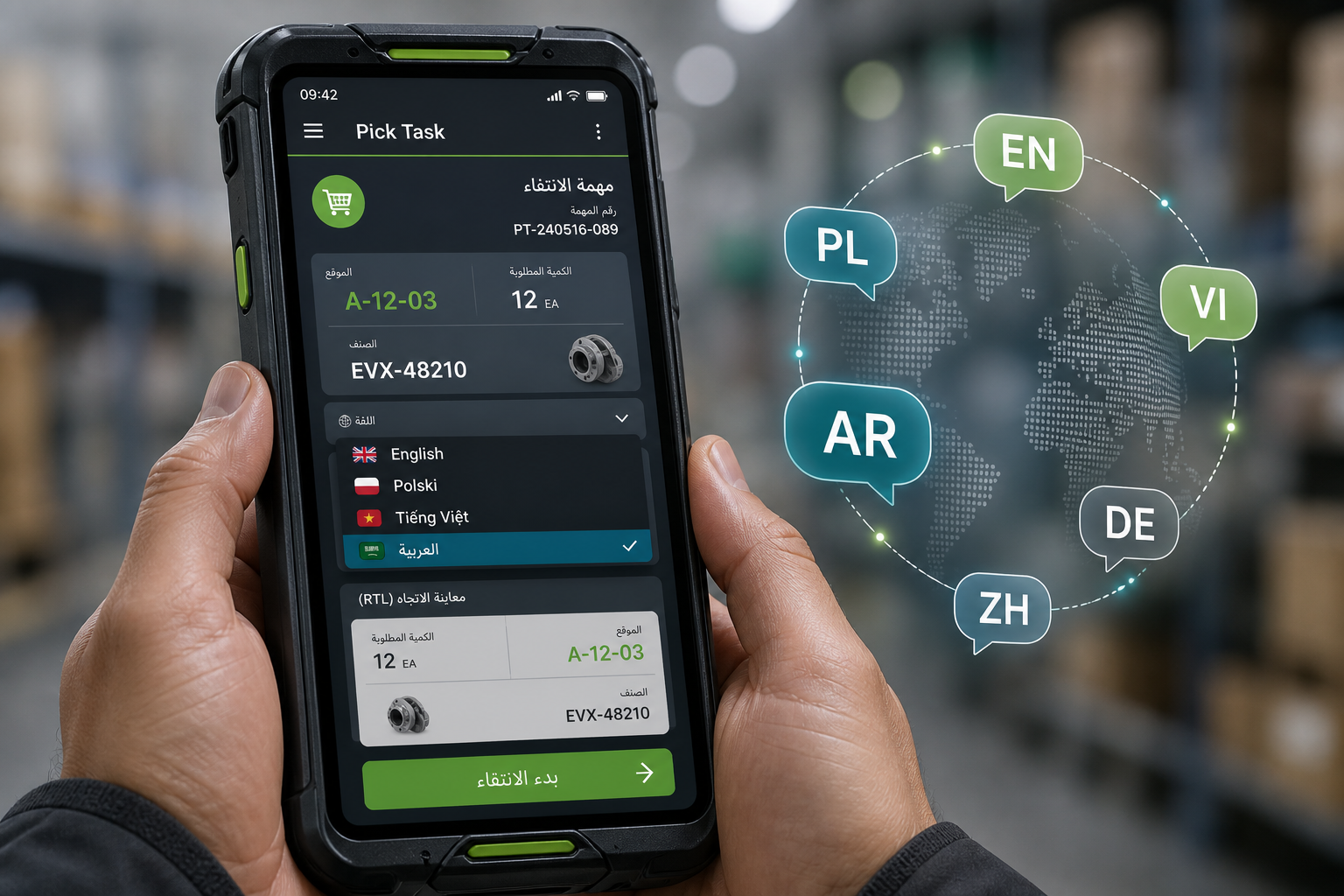
eveXso currently ships native UI support across warehouse, transport, and production for: English, French, German, Spanish, Portuguese, Japanese, Chinese, Polish, Romanian, Lithuanian, Bulgarian, Ukrainian, Punjabi, Vietnamese, Arabic, Te Reo Māori, Samoan, and Tongan. The point is not the count. It is whether the languages your floor actually uses are first-class in the daily workflow.
2. The frontline labour advantage
This is the differentiator most RFPs miss. Head office may run in English. The dock and the pick face often do not.
Seasonal peaks, agency labour, and migrant workforces are normal in food, FMCG, ecommerce, and 3PL. Handing someone a scanner with menus, confirmations, and exception messages in a language they read fluently is not a soft benefit. It is how you get productive shifts sooner and fewer “I thought it meant something else” errors at the carton.
What good looks like on the floor
- Handheld and terminal UIs switchable per user — not a single site-wide language lock
- The same inventory, order, and task data visible to supervisors in English and to pickers in their preferred language
- Safety, quality, and exception prompts written for the operator, not translated as an afterthought
- Driver and production screens included — not WMS-only localisation
“A multilingual WMS is not about sounding global. It is about letting the person holding the scanner work without translating under time pressure.”
3. Outcomes to pitch internally (not just “we support many languages”)
If you are building a business case, frame language support the same way you frame scanning or FEFO: in operational outcomes.
Business outcomes to lead with
- Faster, lower-friction onboarding — seasonal and agency staff ramp sooner when task screens match the language they think in
- Fewer language-driven floor errors — misreads of location, quantity, or exception prompts show up as mis-picks and rework
- Safer comprehension of critical prompts — hazard, quarantine, and quality holds only work if operators understand them immediately
- One platform, local experience — regional managers, supervisors, and floor staff share one live system in their primary languages
4. What to ask vendors (and how to spot shallow localisation)
“We support multiple languages” can mean anything from a partial admin UI to true floor workflows. Pressure-test demos with the questions below.
| Question | Why it matters |
|---|---|
| Can each user set their language on the handheld? | Mixed crews need per-person preference, not one warehouse default |
| Are pick, pack, receive, and exception flows fully translated? | Admin menus in French do not help a Polish picker at 6am |
| Does transport / TMS and production share the same language set? | Drivers and machine operators are part of the same labour story |
| Is Arabic (or other RTL languages) a real layout, not mirrored English? | Proper right-to-left UI is a localisation maturity test |
| Who maintains translations when workflows change? | Machine dump + never updated equals drift and support tickets |
RTL as a maturity signal
Arabic support with genuine right-to-left layout is harder than swapping string files. If a vendor can demonstrate proper RTL on handhelds and web screens, you are usually looking at intentional localisation — not a thin machine-translation layer.
5. For current customers expanding sites
If you already run eveXso (or are shortlisting for a second DC), language coverage is a rollout lever. Opening a site in another region — or hiring a different labour mix for peak — should not force a new local software vendor. The same platform moves with you; you turn on the languages your crew needs.
That also supports staffing resilience. When agency and seasonal pools change year to year, a system that meets workers in their language is easier to keep productive than one that assumes English fluency on day one.
The bottom line
Global readiness is not only about multi-site inventory and ERP sync. It is whether the people executing the work can do so without fighting the interface. Ask for a live demo that toggles English, an Eastern European language, Chinese or Vietnamese, and Arabic RTL on the same order flow. If that looks clumsy, the rest of the “global” story probably is too.
For how language fits into a broader selection process, see our practical WMS buyer's guide for 2026. If picking accuracy is already a pain point, pair this with reducing picking errors with precision tracking.
See multilingual workflows in action. We can walk through handheld and production screens in the languages your floor uses — including how Arabic RTL and European labour languages sit on the same live data your supervisors see in English.
Prefer a conversation? Book a discovery call or email sales@evexso.com.