TL;DR: The Quick Summary for Busy Managers
An agent decides which steps to take and carries them out. A chatbot returns text for a human to act on. That is the whole distinction, and it is the one worth testing. To act on a warehouse an AI needs three things a chatbot does not: a real set of actions to call, permissions that hold when it calls them, and an approval step in front of anything that changes. In a demo, ask it to change something rather than tell you something, then watch whether a human has to go and do it.
Every warehouse management vendor has AI on the website now. Most of it is a search box with better manners.
That is not a criticism so much as an observation about vocabulary. “AI”, “copilot” and “agent” have been stretched across such different products that the words have stopped carrying information. A buyer comparing three systems will see the same term on all three websites describing three genuinely different things, at three quite different prices. The practical way to separate chatbot, copilot and agent in a demo is in a plain-English guide for logistics buyers.
So it is worth being precise, because the distinction has operational consequences.
1. A definition you can actually use
An agent decides which steps to take and carries them out, rather than returning text for a human to act on.
That is it. Everything else — model size, context window, how conversational it feels — is implementation detail. The question is whether the work moves.
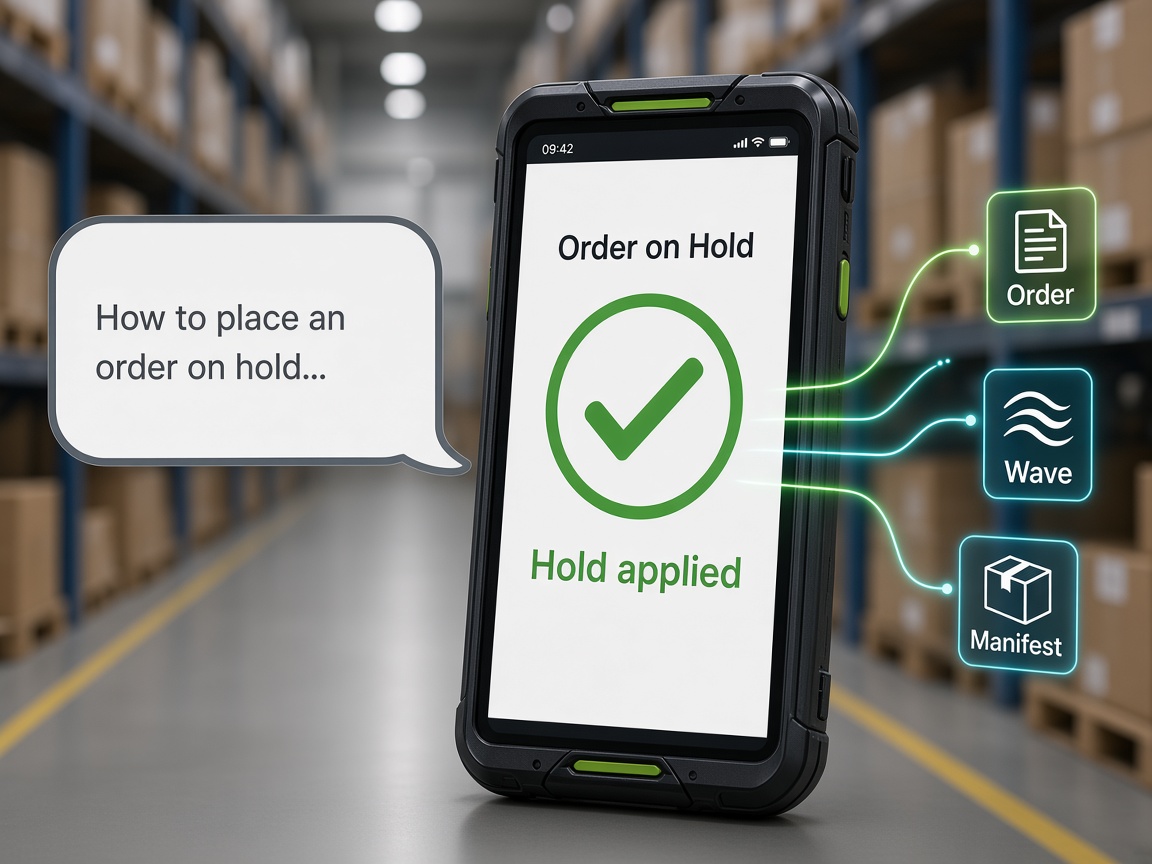
Consider the difference in a single, ordinary request: hold order SO-14822, the customer has gone on credit stop.
What a chatbot does
Explains how to place an order on hold. Possibly very well, with the right menu path and a note about which statuses allow it. You then open the system and do it yourself, which is what you were going to do anyway.
What an agent does
Finds the order, checks whether it has already been picked, tells you what it is about to do, waits for you to approve it, places the hold, and records that it did. The order is on hold when the conversation ends.
Both are useful. They are not the same product, and only one of them reduces the number of things on your list.
2. What acting requires that answering does not
The reason so much warehouse AI stops at answering is that answering is dramatically easier. Acting on a live operation requires three things, and a system missing any one of them cannot safely be an agent no matter how good the model behind it is.
A real surface to act through
The AI needs actual operations it can call — hold an order, reprioritise a wave, adjust a count, raise a manifest — not a text box wired to a documentation index. In practice this means the platform needs a proper API surface that the AI can use, and it needs to be the same one the software itself runs on. If the AI has a special back door that the application does not use, every guarantee the application makes about validation and business rules stops applying the moment the AI acts.
Permissions that hold
An agent has to act as the person who asked, not as itself. If a warehouse operator cannot void a dispatch, they must not be able to get the AI to void one for them. This sounds obvious and is routinely got wrong: the AI is given broad service credentials so that it works reliably in a demo, and the permission model quietly stops meaning anything. The correct behaviour is that every action the AI takes carries the requesting user's identity and session, and the system applies exactly the checks it would if that person had pressed the button themselves.
An approval step
Reading data is low-risk and can happen freely. Changing data is not, and should not. A workable agent separates the two: lookups run immediately, and anything that writes stops and shows you precisely what it intends to do before it does it. This is the part buyers underestimate. It is also the part that determines whether the compliance conversation is short or very long.
The three questions behind the three requirements
- What can it actually do — and is that the same set of operations the application itself uses?
- Whose permissions does it act under when it does them?
- What happens between it deciding to change something and the change happening?
3. What it looks like on a warehouse floor
Abstract definitions are easy to agree with and hard to buy from. Four concrete shapes, in rising order of how much trust they require:
Asking
“What sold best last month?” No report to run, no filter to configure, no export. The interesting part is not the answer — it is that nobody had to know which screen the answer lived on. Most of the day-to-day value of warehouse AI is here, in questions that were previously not worth the effort of asking.
Investigating
“Why can I not see order SO-12345?” This is where an agent separates from a reporting tool. Answering it properly means checking the order, then the integration that should have brought it in, then the error that integration threw, then what that error actually means. That is a chain of steps, each one chosen based on what the last one returned.
Acting
“Put those three orders on hold.” The system states what it is about to do, you approve it, it does it, and the record shows what ran and who authorised it. The approval is not friction to be optimised away later. It is the feature.
Alerting
“Tell the picking team.” Findings are worth little if they stay in a manager's chat window. An agent that can push a notification to the right team closes the gap between noticing something and the floor knowing about it — again, with approval, and to your own people rather than to your customers.
4. Where agentic AI is the wrong answer
A definition that only flatters the category is not much use. There are places where reaching for an agent is a mistake, and knowing them is a reasonable test of whether a vendor is being straight with you.
- Anything safety-critical. Equipment interlocks, hazardous goods segregation rules, load limits. These need deterministic enforcement, not a system that is usually right.
- Anything carrying a legal signature. Customs declarations, dangerous goods paperwork, regulatory attestations. A named human signs those, and it should stay that way.
- Anything a simple rule already handles. If the logic is “when stock drops below X, reorder”, write the rule. It is cheaper, faster, easier to audit, and it behaves identically every time. Reaching for AI where a rule would do is how organisations end up with something impressive that nobody trusts.
- High-volume, unattended, irreversible operations. The approval model that makes an agent safe depends on someone being there to approve. Work that runs unattended overnight at volume wants deterministic automation with proper exception handling.
The useful framing is that agentic AI is strongest where the work is varied, investigative and hard to specify in advance — exactly the work that currently lands on your most experienced people and interrupts them all day. It is weakest where the work is repetitive, high-volume and already well described by a rule.
5. How to tell the difference in a demo
One question settles it, and you can ask it in any demo of any product.
Ask it to change something. Not to tell you about something — to change it. Hold an order. Reprioritise a wave. Then watch what happens next. Either a human goes and does it, or the system does it and tells you what it did.
If a person has to go and perform the change, you are being shown a very polite search box. That may still be worth buying. It should not be priced or positioned as an agent.
Three follow-ups worth having ready, because the answers separate a considered implementation from a demo built for the sales cycle:
- “Show me the same request as a user with fewer permissions.” The answer should change. If it does not, the permission model is decorative.
- “Where is the record of what it just did?” There should be one, it should name the user, and you should be able to see it during the call rather than after it.
- “What can it not do?” A vendor who cannot answer this quickly has either not thought about the boundary or would rather you did not.
Where this leaves you
The category is genuinely new and genuinely useful, and it is also being oversold at the moment. Both things are true. The way through is to stop evaluating the language on the website and start evaluating the behaviour in the demo — which, conveniently, takes about ninety seconds and one awkward question.
eveXso has an agentic AI built in, called Dave. It acts through the same 1,200+ API actions the platform itself runs on, under the permissions of whoever is asking, and it asks before it changes anything. You can read what it can and cannot do in plain terms, or see how it works in more detail. If you are earlier in the process than that, start with what eveXso is.
Ask us the awkward question. Book a discovery call and ask us to change something live. That is the test we would want you to run on any vendor, including us.
Not ready for a call? Start with the AI FAQ for plain answers on what agentic AI can and cannot do in a warehouse.