TL;DR: The Quick Summary for Busy Managers
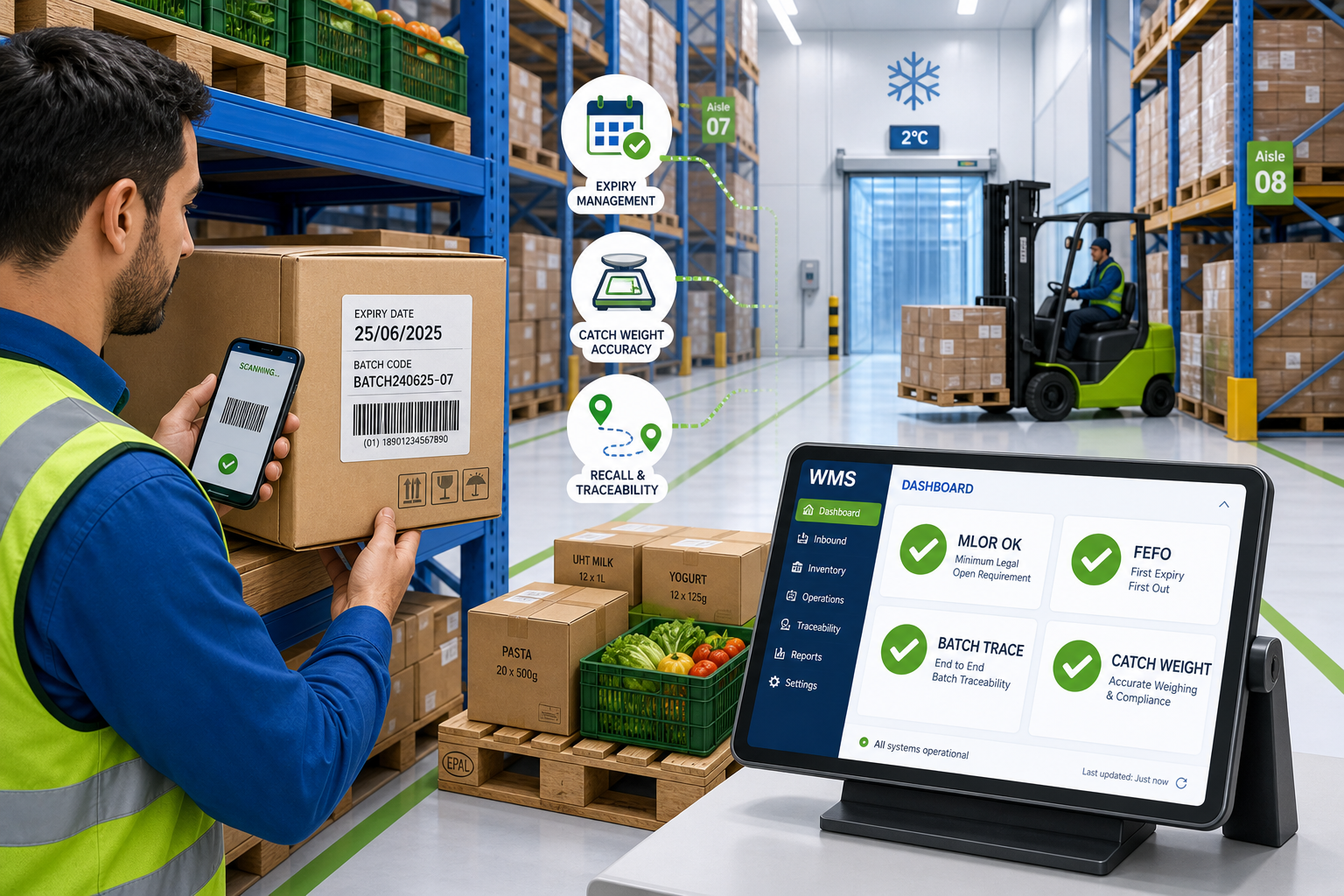
A general-purpose WMS can move boxes. Food and FMCG warehouses need something more specific: expiry control at pick, customer-level MLOR rules, batch traceability for recalls, catch-weight where cartons are not uniform, and GS1 scanning for retailer compliance. If your system cannot enforce those at the scanner — not in a spreadsheet after the fact — you are running on hope.
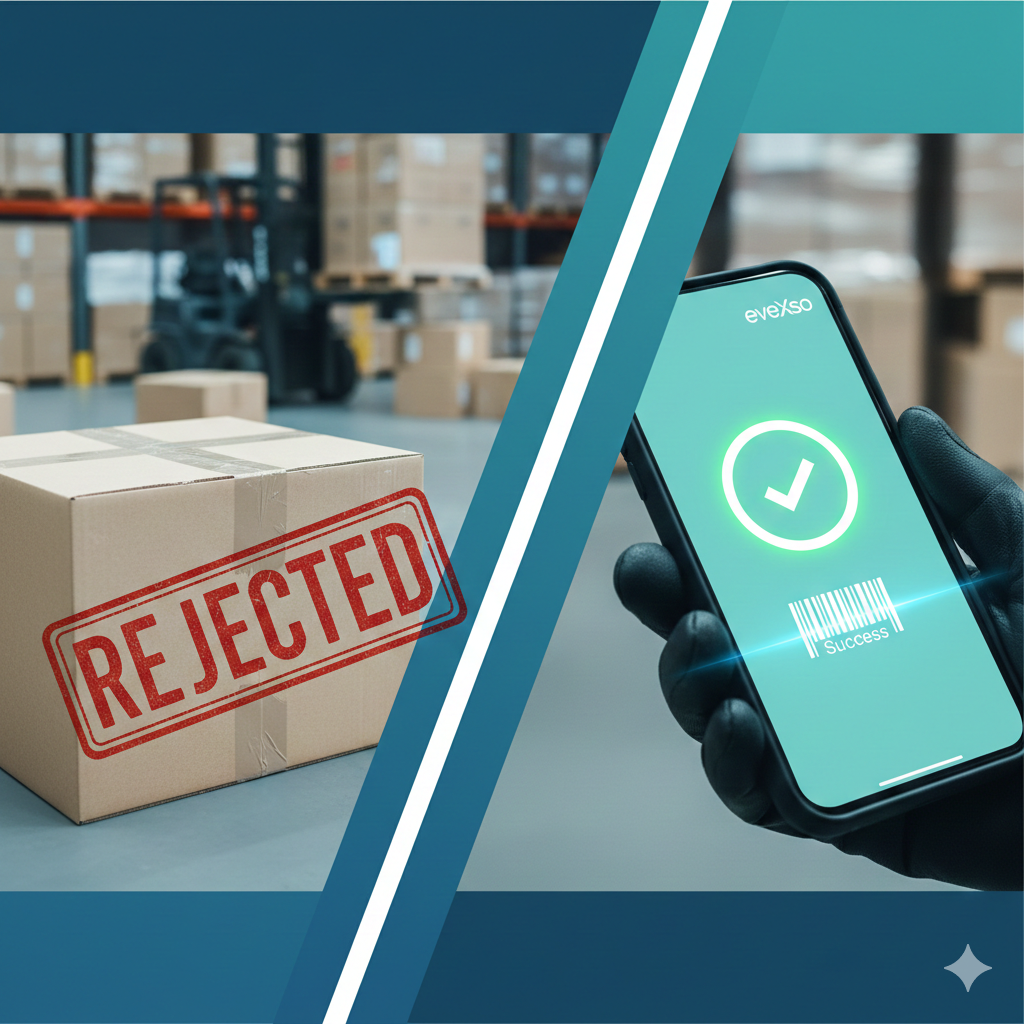
Most distribution centres can get product out the door. The expensive failures in food and FMCG look different: a pallet rejected at a supermarket DC because remaining life was short of the retailer's MLOR; a batch recall that takes a day to untangle because “we think that lot went to...”; cartons shipped at one weight and invoiced at another; stock that “exists” in the ERP but cannot be found — or worse, is past date and still pickable.
That is not a labour problem. It is a systems problem. Your ERP is usually a solid brain for finance and orders. It was never built to run the floor when every carton has a date, a batch, and sometimes a unique weight.
1. Expiry and FEFO — not just FIFO
FIFO (first in, first out) works when stock is undifferentiated. Food is not.
FEFO (first expired, first out) means the system directs pickers to the batch with the earliest acceptable expiry — not whichever pallet is closest to the aisle. Without FEFO on the scanner, short-dated stock sits while longer-dated stock ships, write-offs climb, and you discover the problem at stocktake rather than at pick.
What good looks like
- Remaining shelf life visible at scan
- FEFO as a hard rule — not a suggestion
- Stock that fails the rule blocked before it leaves the pick face
2. MLOR — supermarket compliance at pick, not at the dock
If you supply Coles, Woolworths, or other retail DCs in Australia, you already know the call: “Pallet rejected. Minimum life on receipt not met.”
You picked the right product. The truck was on time. And still — rejected. Chargeback incoming.
MLOR (Minimum Life On Receipt) is the retailer's rule for how much shelf life must remain when the pallet hits their dock. A carton can be fine for your warehouse and still fail their receiving spec. Most ERPs cannot enforce that per customer at pick time — so the picker has no way to know until the DC says no.
What good looks like
- Customer-specific MLOR rules, enforced when the picker scans
- Hard stop if remaining life is too short for that retailer
- Compliance as a floor workflow — not a post-dispatch surprise
See how MLOR enforcement works in practice on our FMCG MLOR section.
3. Batch and lot traceability — because recalls do not wait
When a contamination alert or supplier recall hits, the clock starts. You need answers fast: which batches did we receive, where are they now, and which customers already have them?
Do that with paper dockets and spreadsheets and you are looking at hours — while affected stock may still be shipping.
What good looks like
- Every batch and lot tracked from receipt to dispatch
- Forward and backward traceability already in the system
- Answers in minutes — not an afternoon of cross-referencing
We walk through batch recall — including AI-assisted tracing — in our recall readiness demo.
“Food and FMCG warehouses do not need a more complicated WMS. They need a more specific one — one that treats expiry, batch, weight, and retailer rules as floor workflows, not after-the-fact reports.”
4. Catch-weight — when no two cartons are the same
Meat, cheese, seafood, produce — variable weight is the norm. Many systems still treat a carton as a fixed quantity. Result: you ship one weight and invoice another. A few hundred grams here and there does not feel urgent. Over a year, it is margin walking out the dock door.
What good looks like
- Actual weight captured at receipt and pick
- Dual units of measure — each and kg
- Invoiced weight matching dispatched weight, without a 5pm spreadsheet reconciliation
Watch catch-weight capture at the scan: catch-weight on the FMCG page.
5. GS1 scanning and retailer despatch
Retail and food supply chains run on GS1. A barcode is not just a product number — it can carry GTIN, batch, expiry, weight, and SSCC for the pallet. If your system only reads the GTIN and ignores the rest, you are re-keying data the barcode already gave you — and creating gaps that show up at the DC.
What good looks like
- GS1-128 scanning on everyday devices
- SSCC labelling and ASN-ready despatch
- Workflows built for supermarket compliance — not adapted after the fact
For a deeper look at retailer ASN and label rules, see global retail compliance for Tier 1 distribution.
What to look for in a WMS for food / FMCG
When you are evaluating systems, pressure-test these questions. If the answer is “we handle that in a spreadsheet” or “that is a Phase 2 customisation,” keep looking.
| Question | Why it matters |
|---|---|
| Can MLOR be set per customer and blocked at pick? | Stops rejected pallets |
| Is FEFO enforced on the scanner, or only reported? | Stops short-dated stock shipping late |
| Can you trace a batch forward and back in minutes? | Recall readiness |
| Does catch-weight capture real kg at the scan? | Protects margin |
| Does GS1 scanning capture batch, expiry, and weight in one scan? | Retailer compliance |
| Does it sync to your ERP in real time? | Stops double-keying and “ERP says we have it” |
The bottom line
Food and FMCG warehouses do not need a more complicated WMS. They need a more specific one — one that treats expiry, batch, weight, and retailer rules as floor workflows, not after-the-fact reports.
Your ERP can stay the brain. The WMS needs to run the floor.
See the workflows in action. We have walked through MLOR, batch recall, and catch-weight in more detail — with demo videos — on our FMCG & food distribution page.
Prefer a conversation? Book a discovery call or email sales@evexso.com.